
Study Finds AI Voices Equal Humans On Sound, Not Trust.


Radio listeners largely cannot tell the difference between AI-generated voices and human voice actors in a blind test. But the moment they’re told a voice was created by artificial intelligence, their perceptions change dramatically.
That’s the main finding from a new study by Crowd React Media, which tested AI voice technology with 1,326 weekly radio listeners ages 18 to 45 across the U.S. Rather than relying on opinions about AI, the research played identical station promos voiced either by a professional voice actor or an AI-generated voice. Half the respondents heard the human version, and half heard the AI version, without knowing which they were listening to.
Before the reveal, there were no statistically significant differences in listeners’ ability to identify whether they had heard a human or AI voice. Katie Miller, founder of Crowd React Media and Vice President of Strategy at Harker Bos Group, says the AI voice passed the blind test.
“Listeners can’t tell the difference until you tell them,” she writes in the analysis.
Across two test clips — a station imaging promo and a Mother’s Day reminder — AI and human voices also performed nearly identically on professionalism, authenticity, credibility, energy and likability. Overall appeal was essentially tied, with the AI version actually edging the human voice by one percentage point in one of the clips.
The only area where the human voice showed a measurable advantage was humor. For a promotional script built around a joke, 33% of listeners described human delivery as funny vs. 26% for the AI version. It was the only statistically significant finding in either clip’s performance.
“The human voice was perceived as meaningfully funnier,” Miller says. “Comedy timing, inflection, and the organic quality of a human reading a punchline are things AI hasn’t fully closed the gap on yet, at least not in the ears of radio listeners.”
The biggest differences emerged after listeners were told which version they had heard.
Among those who learned they had been listening to a human voice actor, 48% said they viewed the clip more favorably afterward, while only 4% viewed it less favorably. But among listeners told they had heard an AI-generated voice, 20% said their opinion became less favorable vs. 25% whose opinion improved.
“The performance was the same,” Miller writes. “The perception shifted dramatically the moment people knew the source.”
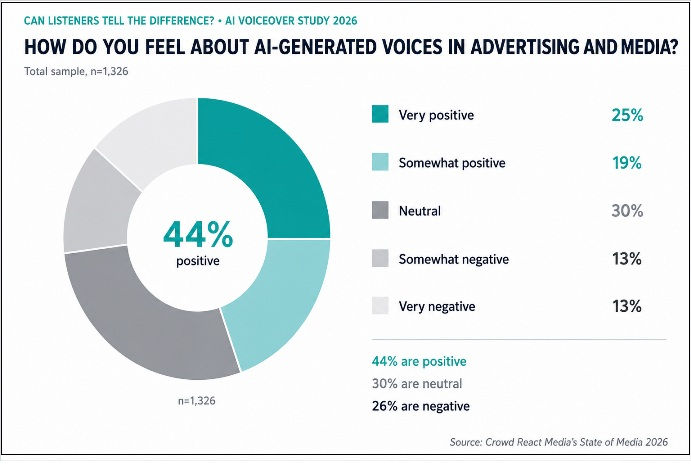
The study also explored attitudes toward AI more broadly. Overall, 44% of respondents said they have a positive opinion of AI-generated voices in advertising and media vs. 26% who view them negatively and 30% who are neutral.
But when asked specifically about radio stations using AI voices, sentiment became more cautious. One-third said they would feel less favorably toward a station that uses AI voices, while 21% said they would feel more favorably and nearly half said it would make no difference.
Crowd React Media’s survey responses suggest listeners distinguish between AI as a production tool and AI replacing radio personalities. Some respondents praised the technology as innovative and said AI was acceptable for “quick little blurbs or commercials.” Others objected less to the sound itself than to what they viewed as deception or a loss of radio’s human connection.
“That nuance matters,” Miller says. “It suggests listeners aren’t categorically opposed to AI in radio production. They’re opposed to feeling deceived, and they draw a distinction between production tools and on-air personality.”

Crowd React says its study shows AI technology has largely overcome questions about audio quality. Instead, the research suggests the bigger challenge for broadcasters going forward is maintaining trust.
“Disclosure is the real variable,” Miller says. “The performance gap is negligible. The perception gap after disclosure is substantial.”


Comments