
Programmatic Audio Buying Has Doubled Since 2022.
- Inside Audio Marketing

- May 5
- 2 min read

Programmatic advertising has seen significant growth over the past four years — most notably, from a year ago — according to a series of studies conducted by Advertiser Perceptions, as reported in Westwood One’s blog.
Programmatic advertising, which has been available for the past two decades in some shape or form, is defined as the automated data-driven buying and selling of digital ad space in real time, replacing manual negotiations with AI-powered, instantaneous auctions. As such, Cumulus Media/Westwood One Audio Active Group Chief Insights Officer Pierre Bouvard says, “it allows advertisers to precisely target specific audiences across websites, apps and streaming platforms in milliseconds, optimizing spend efficiency.”

A look at annual Advertiser Perceptions surveys since 2022 shows use of programmatic advertising among marketers and media agencies has doubled in the past four years, from 41% in 2022 to 82%, based on the most recent study conducted in March of this year. While programmatic advertising grew by an average rate of 8% from 2022 to 2025, it grew by 17% this year vs. 2025.
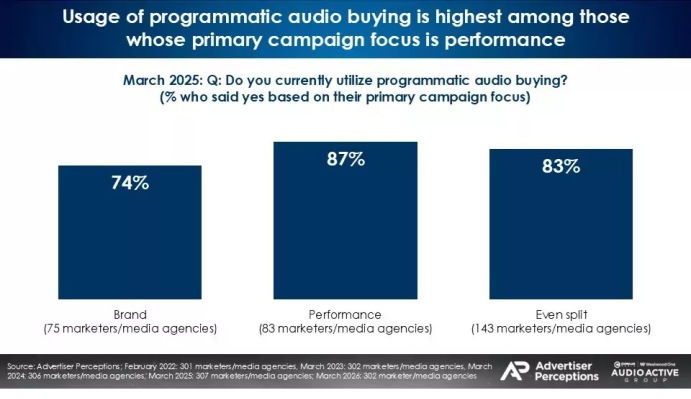
According to the 2026 survey of more than 300 advertisers and agencies, 87% of those whose primary campaign focus is a primary performance strategy have used programmatic audio buying, vs. 74% of those who focus on brand building.

Comparing marketers and media agencies, the latter are more likely to use programmatic audio. That’s been the case since 2022.
Findings from several Advertiser Perceptions studies show that the most used programmatic audio demand-side platforms are Google Display & Video 360, The Trade Desk and Amazon DSP, which are also the top three among those who purchase podcasts. For publishers, the most utilized supply-side platform for digital audio ads is Google Ad Manager, far ahead of Amazon Publisher Services, Open X and PubMatic.

Specific to podcast advertising, more than half of advertisers purchase it programmatically vs. directly, with 40% bought via direct insertion order.
While terrestrial AM/FM radio is not yet able to be purchased programmatically, that’s not so far in the future, according to Amazon Ads, which has hinted at a major expansion of over-the-air AM/FM radio and audio advertising capabilities within Amazon’s demand-side platform. “These moves focus on bridging the gap between traditional broadcast AM/FM radio and digital, programmatic buying, allowing advertisers to use Amazon’s first-party signals for targeting and measurement,” Bouvard says.
The blog notes that iHeartMedia’s partnership expansion with Amazon Ads will add iHeart Podcasts and more than 870 U.S. broadcast AM/FM stations in 2026, aiming to make broadcast AM/FM radio behave like digital media in terms of measurability.
As reported, among Amazon’s new audio offerings are: omnichannel integration, making audio a central component of broader campaigns alongside display and video; using AI for audience targeting and creative optimization; full-funnel measurement connecting audio exposure to actual sales outcomes; and full-funnel tooling, allowing advertisers to set up complete awareness-to-conversion strategies, combining audio and streaming TV for top-of-funnel, while using display for reinforcement.


Comments