
Podtrac: Podcast Listening Surges In March As All Top Publishers Post Gains.


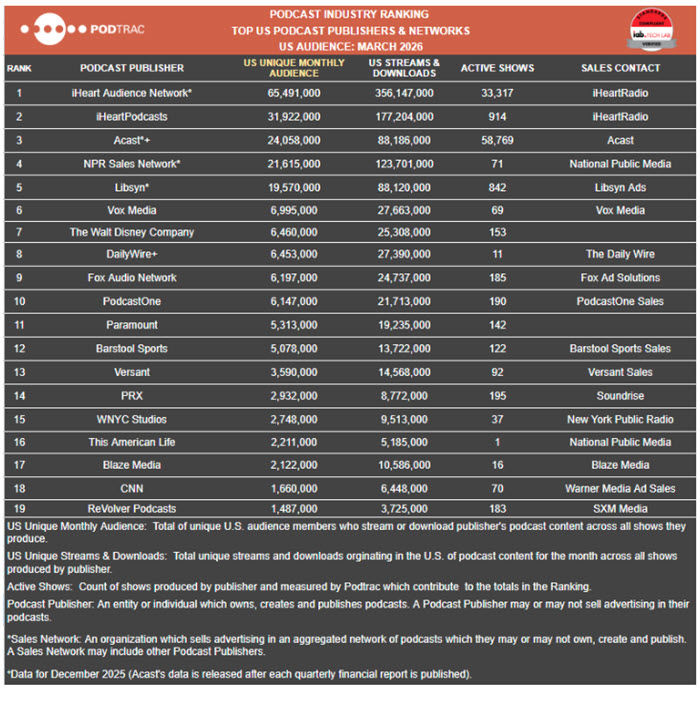
Podtrac says every publisher in the top 20 posted month-to-month gains in both U.S. audience and downloads in March, rebounding from February’s shorter reporting period. In total, downloads across the top 20 publishers rose 11.7% month-over-month, pointing to a broad-based lift in podcast consumption.
The gains were widespread across the leaderboard, with most publishers posting double-digit percentage increases in both audience and downloads from February to March.
Despite the surge, the competitive order at the top remained unchanged. iHeartMedia continued to dominate, with the iHeart Audience Network holding the No. 1 position and iHeartPodcasts again ranking No. 2.
Behind them, Acast, the NPR Sales Network, and Libsyn each held their positions in the top five, while the rest of the top ten — Vox Media, Fox Audio Network, The Walt Disney Company, DailyWire+, and PodcastOne — also remained unchanged month-to-month.
Among the biggest movers, Paramount posted a 21% increase in U.S. audience and a 25% jump in downloads, while This American Life saw audience rise 22% and downloads surge 31% compared with February, making them the standout performers for the month.
Podtrac also added Versant — the parent to MS NOW and other cable networks — to its publisher rankings in March. It debuted at No. 13, behind Fox News but ahead of CNN, mirroring the three cable networks’ television ratings.
Podtrac’s March global delivery rankings also reveal podcast consumption surging worldwide, with YouTube playing an even larger role in driving scale for several of the industry’s biggest networks.
The iHeart Audience Network extended its lead with 871.8 million global streams, downloads and views, a sizable jump from February levels. Of that total, 314.1 million came from YouTube, meaning more than a third of its global consumption is now coming from video platforms, while 557.7 million came via traditional RSS audio delivery.
The growing influence of YouTube is even more pronounced for some publishers. Libsyn, which ranked third globally, generated 338.1 million total deliveries, with 226.5 million coming from YouTube versus 111.7 million from RSS. That means roughly two-thirds of Libsyn’s global footprint is now video-driven, underscoring how aggressively video distribution can expand reach.
By comparison, Acast remained the No. 2 global publisher with 439.8 million streams and downloads, but reported activity entirely through RSS, with no YouTube data included in Podtrac’s chart.
Further down the rankings, Sonoro Global Media posted 81.9 million global deliveries, with a near-even split between YouTube (43.7 million) and RSS (38.3 million), while Paramount also leaned heavily into video, generating 30.1 million YouTube views out of 54.6 million total deliveries.
The March data reinforces a broader shift in podcasting with YouTube increasingly acting as a force multiplier, with some publishers now deriving the majority of their global consumption from video rather than traditional audio feeds.

Podtrac’s March podcast rankings show with news programming continuing to dominate and only modest movement within the Top 10. “NPR News Now” held onto the No. 1 position for another month, followed by “The Daily” from The New York Times at No. 2 and NPR’s “Up First” at No. 3. The top five remained unchanged overall, with “Dateline NBC” at No. 4 and “Fox News Hourly Update” at No. 5.
NPR’s “NPR Politics Podcast” posted the biggest jump in the March rankings, climbing 10 spots as interest in political news intensified. Meanwhile, after re-entering the rankings in February, “The Dan Bongino Show” slipped slightly in March, falling two positions to No. 11, but remaining within striking distance of the top 10.

The rankings are based on Podtrac measurement data for U.S. unique monthly audience for any show that was measured for the entire month. While measurement is free for any podcast, the ranking only includes those shows that have opted in. It means that some of the biggest podcasts, like “The Joe Rogan Experience,” and shows from companies like SiriusXM, Spotify and Wondery, are not included in the measurement.


Comments