
Podcasting's Next Challenge: Turning Reach Into Habit.


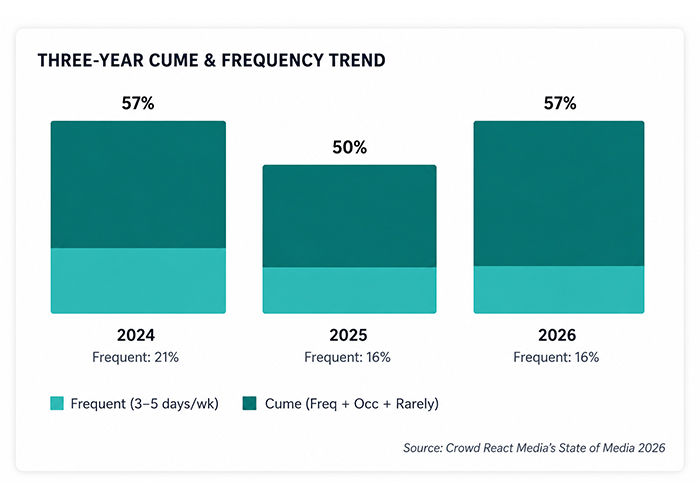
Podcasting has regained the audience it lost a year ago and the industry's next growth opportunity is turning those listeners into regular users. That is one of the central conclusions in Crowd React Media's newly released "State of Media 2026" report, which finds podcast weekly reach rebounded to 57% of U.S. adults after slipping to 50% in 2025. The recovery returns podcasting to the same level measured in 2024, making it one of just four media categories to regain audience over the past year.
But while more Americans are listening, fewer are making podcasts part of a regular routine, according to a survey of 1,094 U.S. adults age 18 and older fielded in March and April.
"Cume bounced back," the report says. "But frequent listening has held flat at 16% for two consecutive years while the occasional audience grew. As the audience widens, it also grows shallower."
Crowd React argues the numbers illustrate a broader shift occurring across nearly every major media platform. Rather than abandoning media altogether, consumers are engaging with more outlets less frequently, a trend the report labels "habit softening."
For podcasts, the report says the medium's conversion rate — the percentage of its total audience that listens three to five days per week —has declined for three consecutive years, falling from 37% in 2024 to 32% in 2025 and 28% this year.
"The audience is growing. The habit is not," the report concludes.
That leaves podcasting with the lowest conversion rate among the nine major media categories measured in the study. While radio, news and even cable television maintained relatively stable audience habits, podcasting experienced one of the steepest declines in listener loyalty between 2025 and 2026.
Even so, the study also reinforces podcasting's role as a companion medium, with 74% listening while doing something else. Most listeners develop small, loyal rotations of shows rather than constantly seeking new content, although discovery continues to rely heavily on outside platforms.
Nearly two-thirds (62%) discover podcasts through social media, rising to 73% among adults 18-34, while 51% cite YouTube. By comparison, only 16% find new podcasts through word of mouth, leading the report to conclude the medium "works against organic sharing."
The findings do not suggest audiences are losing interest in podcasts. Instead, Crowd React says consumers increasingly sample shows without developing the repeat listening patterns that characterized earlier years of podcast growth.
The report ties that behavior to a broader fatigue with algorithm-driven media. As consumers spend less time endlessly scrolling feeds, they are becoming more selective about where they invest sustained attention. Podcasting benefits from that environment because it represents a more intentional form of media consumption, but it still must compete for a permanent place in consumers' routines.
"There is a growing anti-algorithm sentiment visible in consumer behavior," the report says. "The opportunity is not in chasing the algorithm. It is in being the thing people choose when they are tired of being chosen for."
Crowd React says the implications for podcast publishers are clear. Growth strategies centered exclusively on expanding reach or generating clips for social media may increase discovery, but they do not necessarily create loyal listeners.
Instead, the report argues publishers should focus on converting occasional listeners into habitual ones, using social platforms to funnel audiences back to full episodes rather than replacing the core listening experience.
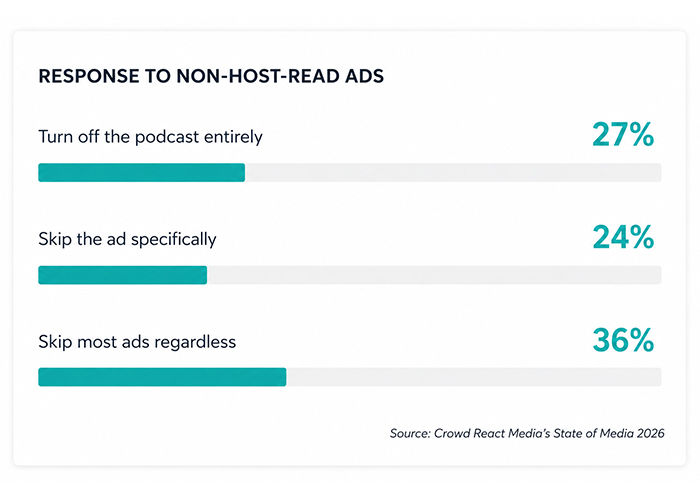
Podcasting's greatest advertising advantage may be the trust listeners place in hosts. Crowd React says host-read endorsements should be viewed as part of the product itself, not simply an ad format, with 51% of podcast listeners saying they take negative action when ads are not read by the host—including 27% who turn off the podcast entirely and 24% who skip the ad.
The study also positions podcasts within a broader media environment where audiences increasingly assemble their own mix of platforms throughout the day. For news consumption, podcasts rank behind online news, television, apps and news/talk radio, suggesting they are becoming one component of broader media diets rather than a standalone destination.
Download Crowd React Media’s State of Media 2026 HERE.


Comments