
Nielsen: Radio Maintains Dominance In U.S. Audio Market.


Radio strengthened its position in the U.S. audio landscape during the first quarter of 2026, increasing its share of daily listening across key demographic groups even as consumers continued to navigate a growing number of media options, according to new data from Nielsen and Edison Research.
The findings were released in “The Record: Q1 U.S. Audio Listening Trends,” a quarterly report examining how Americans spend their listening time and how that usage translates within the ad-supported audio marketplace.
Americans spend nearly four hours each day with audio, the report found. Within the ad-supported audio universe, AM/FM radio — including both over-the-air broadcasts and digital streaming — and podcasts accounted for 82% of all daily listening time. Streaming music services captured 16% of daily ad-supported audio listening.
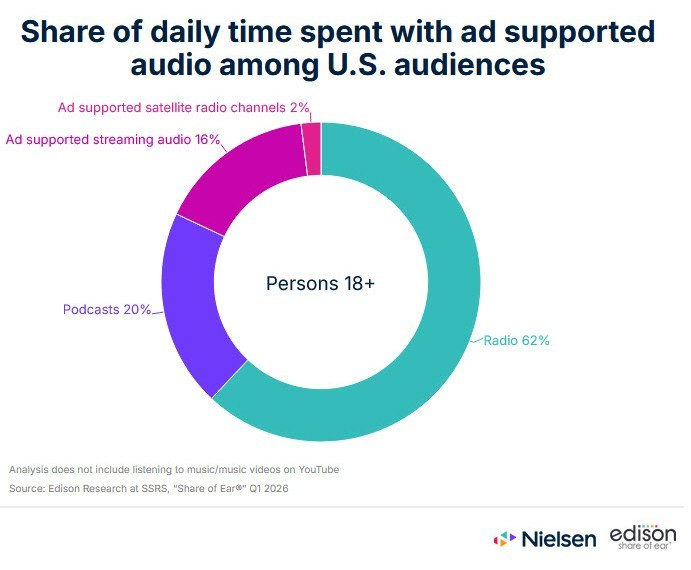
Nielsen’s report also touts the power of combining podcasting with AM/FM radio.
“The sustained growth of podcasting paired with radio’s stable foundational reach reinforces a clear truth for media planners: if you are not building audio campaigns around a combined radio and podcast strategy, you are missing the vast majority of the daily ad supported audio audience,” Nielsen says.
The first quarter also brought gains for radio listening overall, with several formats benefiting from seasonal trends and heightened audience interest.
News/Talk remained the nation’s largest radio format among adults 18+, increasing its share of total radio listening to 10.9% from 10.8% in Q4 2025. All News stations also posted gains, rising to a 2.9% share from 2.7% in the previous quarter. Nielsen attributed the increases to strong public interest in major domestic and international news developments during the quarter.
Adult Contemporary experienced the largest decline among major formats after benefiting from holiday music programming during Q4. The format’s audience share fell to 7.1% in Q1 from 8.4% in the previous quarter, returning closer to historical norms.
Several music formats remained stable or posted gains despite the post-holiday adjustment. Country maintained a 5.8% share of listening, while Pop Contemporary Hit Radio held steady at 4.3%.
Among younger listeners 18 to 34, Classic Hits increased its share from 5.1% to 5.4%, while Hot Adult Contemporary rose from 4.9% to 5.6%. Alternative stations also gained audience share among younger listeners, climbing from 3.8% to 4.2%.
Formats targeting Black and Hispanic audiences also showed growth. Urban Adult Contemporary/R&B maintained a 5.1% share among adults 18 and older, while Urban Contemporary/Hip-Hop/R&B increased from 2.7% to 2.8% overall and from 4.6% to 4.8% among listeners ages 18 to 34.
Mexican Regional stations posted a 3.1% share of listening, up from 3.0% in Q4, while their share among younger listeners increased from 3.4% to 3.6%.
The report noted that radio continues to perform strongly across both traditional broadcast listening and digital streaming platforms. Nielsen said the data underscores radio’s ability to maintain broad audience reach despite increasing competition from streaming and other digital media services.
“As the Q1 2026 data continues to demonstrate,” Nielsen’s report says, “radio commands the dominant share of U.S. consumers’ ad-supported audio listening time, anchored by a widening reach across key consumer segments.”


Comments