
Radio Positioned As Cost-Effective Alternative As 2026 Political Ad Spend Surges.
- Inside Audio Marketing

- Apr 7
- 2 min read

This year’s midterm elections have already dominated the headlines, and with a lot at stake, political advertising is expected to see another record spend. An analysis in Westwood One’s blog makes a strong argument for moving some of that ad spend from YouTube and connected TV to AM/FM radio.
“Because 2026 political spending is projected to reach a record $11.2 billion, mirroring the intensity of a presidential year, costs are already nearly double the standard platform averages in key battleground markets, [and] CPMs will get pricey,” Cumulus Media/Westwood One Audio Active Group Chief Insights Officer Pierre Bouvard says. “Political inventory on YouTube and CTV will be overwhelmed, and CPMs will increase massively, [but] AM/FM radio is a surprising alternative that can generate strong voter reach and impact.”

Based on total tuning minutes to ad-supported audio, according to Edison Research’s 2025 quarterly “Share of Ear” reports, AM/FM radio’s share is a commanding 64% among registered voters age 18+, with similar dominance among Independents, Republicans and Democrats.
“Among voters, AM/FM radio is the centerpiece of audio,” Bouvard says, noting that voters are not just listening to spoken word formats such as news, talk or primarily sports, as music-based formats account for 62-72% of listening time.
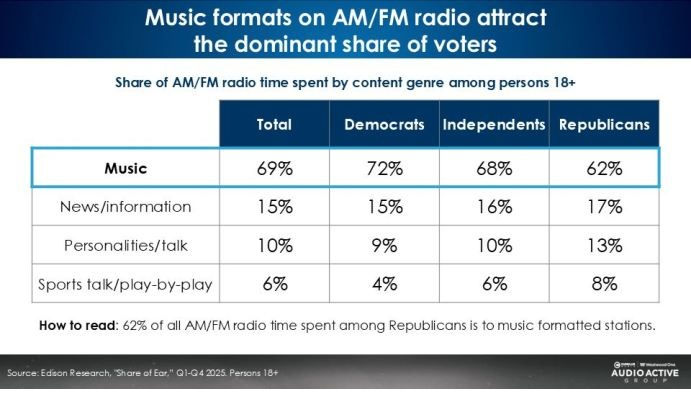
Overall, voters spend the largest share of time with AM/FM radio while in their cars – vs. at home, work or some other place – with radio’s share of ad-supported time in vehicles at 80%. “Consumers in the car are a captive audience,” Bouvard says. “With most car commutes a solo affair, it is impossible to reach consumers in the car with any form of video or social media. AM/FM radio generates a massive surge of incremental reach with its in-car audiences.”

Also working in AM/FM radio’s favor: according to Edison, digital audio choices such as podcasts or music streaming reach only 33% of Americans in a typical day, as opposed to 58% for AM/FM.

A media plan exclusively focused on digital misses most persons 18+, while adding AM/FM radio boosts that reach to 75%. “AM/FM radio adds massive incremental reach,” Bouvard says. “Adding AM/FM radio to digital audio causes reach to soar.”


Comments