
Podcast Ad Spending Holds Steady in March; Quince Holds Top Spot, Magellan Finds.


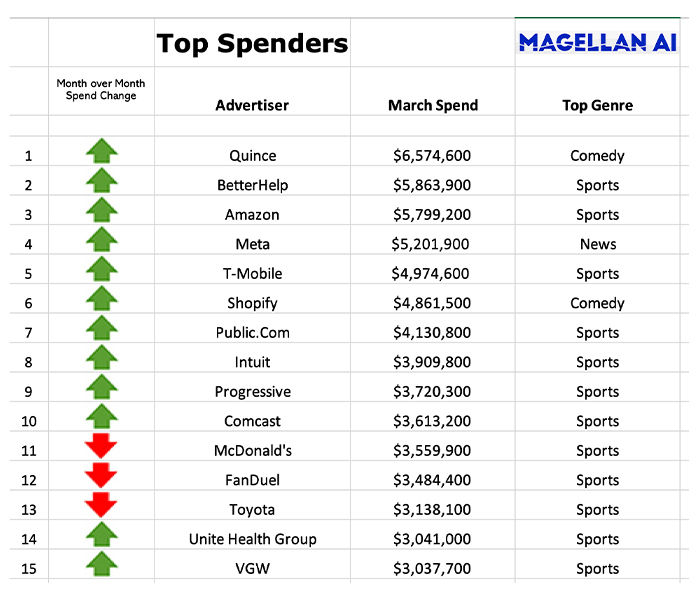
Podcast advertising spending held relatively steady in March, with the top 15 advertisers investing an estimated $58 million, a slight dip from February’s $61.4 million total. According to monthly tracking data from Magellan AI, all but three of the top 15 boosted spending month-to-month.
Fashion and home retailer Quince remained the top podcast advertiser, spending $5.9 million, followed by BetterHelp at $5.4 million, reinforcing both brands’ consistent presence at the top of the rankings. Amazon moved into third place with $5 million, while Meta ranked fourth at $4.7 million, standing out as one of the few major advertisers leaning into news programming rather than sports.
Telecom and commerce brands remained deeply embedded in the channel. T-Mobile spent $4.5 million, while Shopify followed at $4.1 million, with both continuing to prioritize scale through podcast advertising. Financial platform Public.com ranked seventh at $3.6 million, closely followed by Intuit at $3.5 million, as tax-season marketing continued to support strong fintech spending.
Insurance, media, and legacy brands also showed continued investment. Progressive spent $3.4 million, while Comcast reached $3.3 million, signaling ongoing interest from large national advertisers. McDonald’s, which led February’s movers and shakers, remained active with $3.1 million in spending.
Thanks in part to March Madness, Magellan says sports betting and automotive advertisers round out the leaderboard. FanDuel spent $3 million, Toyota invested $2.9 million, and the online gaming company VGW entered the top tier at $2.8 million, while Apple closed out the top 15 at $2.5 million.
As in prior months, sports podcasts dominated advertiser preferences, serving as the primary genre for a majority of top spenders. Only a handful of brands — including Quince, Shopify, and Meta — leaned into comedy or news content.
The March data also provides a clearer picture of first-quarter pacing for podcast advertising. Based on Magellan estimates, the top 15 advertisers spent a combined $59.8 million in January, $61.4 million in February, and $58 million in March, for a first-quarter total of roughly $179 million. The figures point to a relatively steady market despite economic uncertainties and the normally slower pace of Q1 marketing activity.
Podcast advertising continued to draw in a new wave of fast-scaling advertisers in March, with Magellan’s “movers and shakers” once again highlighting brands rapidly increasing their podcast investments. The group’s elevated spending levels — roughly in line with February — show several brands made notable jumps after limited or no activity in February. Companies including Redfin, Depop, and Best Western Hotels & Resorts either entered or re-entered the medium. Crypto platform Kraken and AI company Anthropic also posted some of the largest percentage increases, reflecting continued expansion from emerging and tech-focused categories.
Consumer, travel, and enterprise brands were also well represented among March’s fastest growers. PepsiCo and Dell continued to build on February gains, while Meta remained active as it expanded its podcast footprint. At the same time, brands like Subaru and ISSA showed how advertisers can quickly move from small test budgets to more substantial investments within a single month.
Taken together, first quarter data also highlights the growing role of emerging advertisers in driving incremental spending and moving the industry beyond the $3 billion in annual revenue mark. Magellan’s “movers and shakers” spent $15.4 million in January, $21.7 million in February, and approximately $21.7 million again in March, for a combined quarterly total of roughly $58.8 million.

Magellan AI analyzes podcast advertising data from the top 3,000 podcasts in the U.S., as ranked by Apple Podcasts. Its proprietary model estimates spend based on ad load, episode downloads, and CPM benchmarks derived from media kits and market data.


Comments