
IAB Boosts 2026 Ad Outlook As Audio Remains In Growth Mode.


The Interactive Advertising Bureau has become more bullish on the U.S. advertising market, raising its 2026 growth forecast to 12.3% after a stronger-than-expected first half — with podcasts expected to remain one of the faster-growing media channels.
The IAB update lifts its full-year ad spending forecast by 2.8 points from the 9.5% growth projected in January. The findings are based on insights from more than 200 brands and ad agency decision-makers in which the organization says the feedback shows the Winter Olympics and World Cup helped deliver a strong first half, while advertisers have become less concerned about economic headwinds.
“The first half was strong, major live events delivered, and advertisers have increasingly powerful tools in their arsenal to find and engage customers,” CEO David Cohen says.
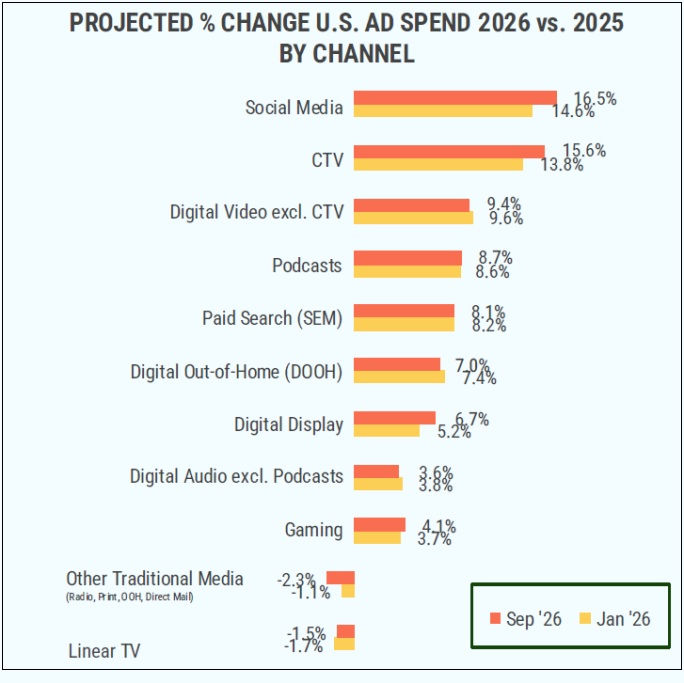
For audio, podcasts continue to be a bright spot. IAB projects podcast ad spending will increase 8.7% this year, slightly above the 8.6% growth forecast in January. That puts podcasts ahead of other digital audio in the industry’s growth rankings, as well as paid search, digital out-of-home, digital display, and gaming advertising.
The rest of the digital audio business is also expected to expand. Digital audio excluding podcasts is forecast to grow 3.6% vs. 2025. Together, the projections have advertisers increasing their investment in both major pieces of digital audio, although podcasts are growing at more than twice the rate of other digital audio.
Social media remains the fastest-growing channel, with spending forecast to rise 16.5% this year, followed by connected TV at 15.6%. Commerce media is projected to increase 13.6%, while digital video excluding CTV is forecast to grow 9.4%.
There are other potentially favorable signals for audio based on where advertisers plan to pay attention in the second half. Customer acquisition is now a top media investment goal for 63% of buyers, jumping nine percentage points since January. Building brand equity rose six points to 43% as marketers look to win consumers who have become more willing to switch brands and retailers.
“The economy has real areas of uncertainty. There is growth to be found, but there are no easy wins,” Cohen says. “When consumers are considering their next purchase, the brands that win will be connecting with them at the right time, in the right context, and with a compelling message.”
Traditional media faces a tougher forecast. IAB doesn’t break out radio separately, instead combining it with print, traditional out-of-home and direct mail. Buyers expect spending across that group to decline 2.3% in 2026, compared with the 1.1% decrease forecast in January. Linear television is projected to decline 1.5%, slightly better than the 1.7% drop expected at the beginning of the year thanks in part to political ad spending.
The outlook comes as advertisers put greater emphasis on finding new customers. Customer acquisition jumped nine percentage points from January to 63% as a top media investment goal, while building brand equity increased six points to 43%.
“Consumers are becoming more discerning,” IAB VP Chris Bruderle says. “For brands, that means two things. They need to make sure their brand equity is strong, particularly in AI environments. And if people are more willing to switch brands, there’s an opportunity to acquire new customers.”
The types of advertising getting greater attention overlap with some of audio’s strengths. Creator and influencer advertising and partnerships top the list, with more than half (54%) of buyers saying they are increasing focus on them. Demo- and cohort-targeted advertising follows at 53%, while 48% are increasing their focus on publishers with first-party data.
Adapting To AI
AI is meanwhile emerging as one of the biggest forces, changing how advertisers find consumers. Adapting to evolving consumer behavior, including AI-driven search, is now the top media investment challenge, cited by 44% of buyers. And 76% say they are increasing their focus on optimizing content to appear in AI-generated answers.
“What we are seeing is a pretty meaningful evolution in the AI conversation,” Bruderle says. “Marketers have spent a lot of time asking, ‘How can I use AI?’ Now the question is becoming, ‘How do I reach a consumer who uses AI?’”
That shift is forcing changes in measurement. IAB says 86% of buyers are already changing, or expect to change, how they measure media performance during the next year. Nearly half are measuring brand visibility and citations directly inside AI tools.
For media sellers, IAB says the changing market makes audience capabilities increasingly important. Its recommendation is to “package audiences, not impressions,” emphasizing first-party data, contextual signals and cohort-ready packages. It also points to creator integrations as an increasingly important tool for reaching consumers — another trend that could work in audio’s favor.
Download the IAB’s updated 2026 Outlook HERE.


Comments