
Creative Drives Sales, But Marketers Still Underrate It.
- Inside Audio Marketing

- Apr 14
- 2 min read

When it comes to estimating the sales contribution of five ad effect factors — brand, creative, reach, recency and targeting — marketers continue to mostly miss the mark.
That’s based on the most recent results from the Cumulus Media/Westwood One Audio Active Group’s annual survey of brands and media agencies, conducted by Advertiser Perceptions, compared to actual sales effect data from market research company Circana, as reported in Westwood One’s blog.
The main takeaways? Marketers and media agencies significantly underestimate the value of creative, while significantly overestimating targeting’s effect. Overall, four of the five sales drivers show a wide gap between perception and reality, with brand the only one marketers and media agencies get right.

In terms of creative — which Circana notes involves “two factors motivating consumer purchase decisions: the creative message, and the context in which it’s delivered” — the gap between perception and reality is the widest. The more-than-300 brands and agencies surveyed in February 2026 pegged creative’s contribution to sales at an average 23% vs. the actual 49% based on a study of nearly 450 advertising campaigns conducted by Circana’s NCSolutions.
“Creative, according to Circana, drives half of sales. This is more than two times what advertisers perceive,” Cumulus Media/Westwood One Audio Active Group Chief Insights Officer Pierre Bouvard says. “Marketers and media agencies massively understate the immense sales effect power of creative.”
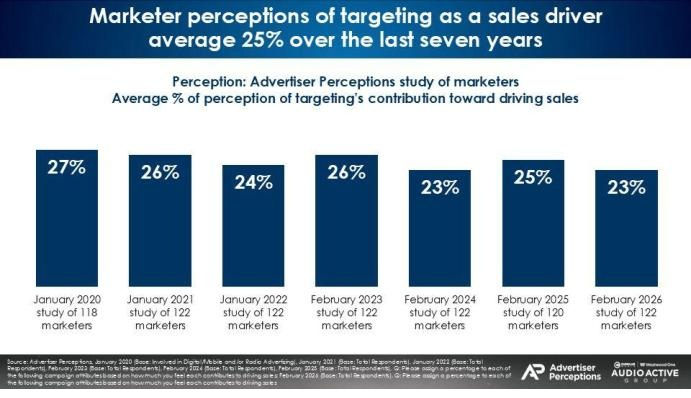
A look at the past seven years of Advertiser Perception surveys shows marketers have consistently undervalued creative. “This data doesn’t surprise me,” Andrew Tindall, Chief Growth Officer of creative testing company System1 says in the blog. “Marketers spend far too much time worrying about anything but the one singlehanded thing that could change their business that quarter – creative effectiveness.”
The reality suggests, Bouvard says, that “creative quality should be the top priority. If possible, pre-test creative. Fixing audio creative is inexpensive: you don’t have to fly the crew back to Cancun to reshoot.”

So, why the reverse trend for targeting, which Circana defines as “the measure of how well a campaign was able to reach a particular audience” and which generates just 11% of sales effect?
“The sales contribution perception of targeting is twice the reality,” Bouvard says, citing insights from Colgate Palmolive’s former VP Insight and Analytics, Elyse Kane, in MediaPost: “Many companies mis-define their targets; many companies define their targets too narrowly; people aren’t static, they move in and out of targets.”

Looking at both groups in Advertiser Perceptions’ sample separately, Bouvard says, “For the most part, marketers and media agencies have similar perceptions on the sales effect contribution. [While] both groups overestimate the importance of targeting, it is interesting to note that among media agencies, creative edges out targeting as a sales driver. It appears media agencies recognize the importance of creative as a sales driver to a greater degree than their marketer clients.”


Comments